
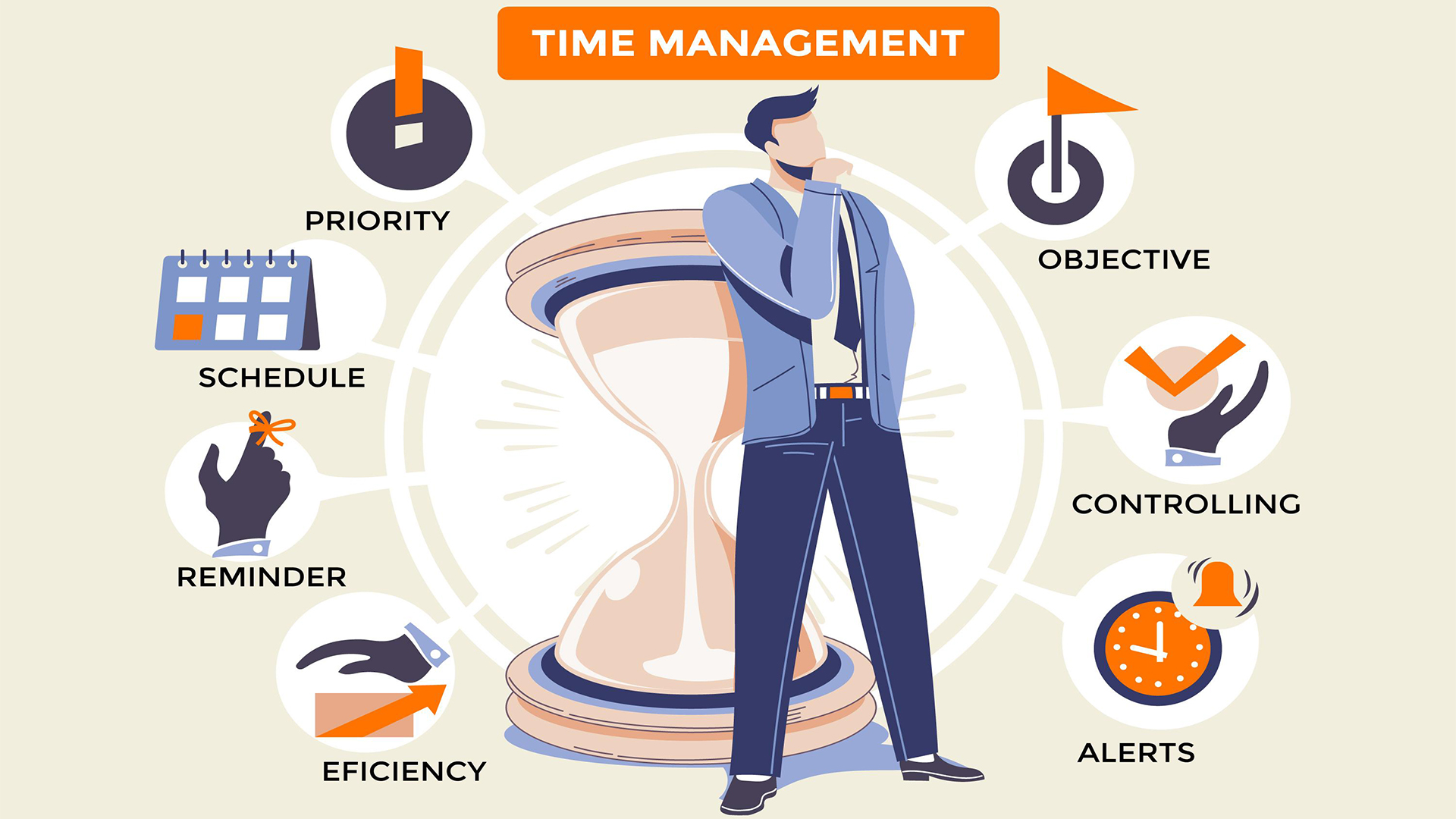
Become An Efficiency Expert With Time Management
 Download Brochure
Course overview
Are you able to effectively distribute your time throughout the day? Alternatively, do you consistently find yourself in a rush? In a world where time is money, professionals must have excellent time management skills to succeed in any workplace.
Overstretching a time crisis at work has an impact on social, personal, and family life. People who are proficient in time management are more likely to succeed because they can control their task instead of responding to interruptions one after another.
Do the responsibilities of life, including work pressure, make you feel overburdened and burned out? In the workplace of today, interruptions, pointless gatherings, and a perpetually shifting schedule of appointments, plans, rosters, and deadlines are all too common.
Time management and classification will always be a struggle for anyone who wants to concentrate on the important things. Every minute of the day matters, and how you choose to spend it affects both your lifestyle and your business.
A healthy work-life balance is essential in today’s cutthroat society. An effective time management tool enables people to concentrate on the activities that will increase their company’s profitability while also leading happier lives.
Time management is a taught ability that must be developed via better planning. With the help of this training program from Training Bee, you will learn about systematic time management methods and how to effectively schedule tasks according to priority levels.
Time management without knowing and establishing your priorities is like shooting arrows into the air without knowing what you want to accomplish and when.
Managing “time-stealers,” who divert attention and impair concentration, is another aspect of this program that addresses time constraints.

Introduction
Although time is a limited resource, the way we use it may have a big impact on our quality of life, productivity, and stress levels. The purpose of this course is to provide you with the skills, techniques, and attitude required making the most of your time and accomplishing your objectives more quickly.
Participants will receive useful ideas, real-world examples, and hands-on exercises to assist you in incorporating these tactics into your everyday practice throughout this course. Recall that the goal is to maximize your time rather than just manage it so that you can live a more contented and balanced life.
We are The Training Bee, a global training and education firm providing services in many countries. We are specialized in capacity building and talent development solutions for individuals and organizations, with our highly customized programs and training sessions.

Learning Objectives
Upon completing Time Management Skills Training Course, participants will be able to:
- Set goals, make plans, and efficiently organize your everyday activities.
- Discover how to stop procrastinating.
- To maximize your time, arrange your workspace and process.
- Effectively Assign Assignments
- Organize business meetings more skillfully.
- Determine who are the “time stealers” and deal with them accordingly.
- Develop your planning, scheduling, and prioritizing abilities.

Our Unique Training Methodology
This interactive course comprises the following training methods:
- Journaling – This consists of setting a timer and letting your thoughts flow, unedited and unscripted recording events, ideas, and thoughts over a while, related to the topic.
- Social learning – Information and expertise exchanged amongst peers via computer-based technologies and interactive conversations including Blogging, instant messaging, and forums for debate in groups.
- Project-based learning
- Mind mapping and brainstorming – A session will be carried out between participants to uncover unique ideas, thoughts, and opinions having a quality discussion.
- Interactive sessions – The course will use informative lectures to introduce key concepts and theories related to the topic.
- Presentations – Participants will be presented with multimedia tools such as videos and graphics to enhance learning. These will be delivered engagingly and interactively.

Training Medium
This Time Management Skills Training Course training is designed in a way that it can be delivered face-to-face and virtually.

Course Duration
This training is versatile in its delivery. The training can be delivered as a full-fledged 40-hour training program or a 15- hours crash course covering 5 hours of content each day over 3 days

Pre-course Assessment
Before you enroll in this course all we wanted to know is your exact mindset and your way of thinking.
For that, we have designed this questionnaire attached below.
- What are the typical obstacles you encounter in your efforts to efficiently manage your time?
- Can you pinpoint particular hobbies or time-wasting behaviors that reduce your productivity?
- For your jobs or projects, how do you typically set goals?
- In your everyday routine, how do you discern between important and urgent tasks?
- Which techniques or resources do you presently employ to plan out your work and schedule?
- How regimented is your long-term, weekly, or daily planning process?
- Which types of distractions are most frequent in your workplace?
- How do you usually reduce or control these distractions so that you can stay focused?

Course Modules
This Time Management Skills Training Course covers the following topics for understanding the essentials of the Agile Workplace:
Module 1 – Overview of Time Management
- Recognizing the importance of time management in both personal and professional contexts.
- Recognizing typical time wasters and the effects they have on output.
- Outlining the fundamentals of efficient time management.
Module 2 – Prioritizing and establishing clear goals
- Establishing objectives for both work and personal life that complement time management techniques.
- Recognizing the difference between critical and urgent jobs.
- Arranging jobs according to priority using methods such as the Eisenhower Matrix or ABC approach.
Module 3 – Organizing and Preparing
- An introduction to the several planning tools (calendars, digital apps, planners) available for scheduling and task organization.
- Making a long-term, weekly, and daily strategy that is structured.
- Putting tactics into practice for efficient work organization.
Module 4 – Time Monitoring and Evaluation
- Methods for monitoring time so you can see where it’s being spent.
- Examining time-tracking data to find trends and potential areas for development.
Module 5 – Performing Tasks Effectively
- Techniques for controlling distractions and beating procrastination.
- Utilizing batching and time blocking strategies to increase productivity and focus.
- Putting multitasking techniques into practice when needed.
Module 6 – Both Outsourcing and Delegation
- Recognizing the art of delegating to maximize productivity.
- Determining which tasks are eligible for delegation and which people to assign them to.
- Looking for opportunities for outsourcing work that doesn’t fit inside core capabilities.
Module 7 – Stress Reduction and Work-Life Harmony
- Recognizing the connection between effective time management and stress.
- Methods for preserving a positive work-life balance and controlling stress.
- Techniques for taking care of oneself and preserving one’s wellbeing in the face of work obligations.
Module 8 – Evaluation and Ongoing Enhancement
- Assessing the efficiency of time-management techniques.
- Creating a customized action plan for ongoing development.
- Establishing a framework for continuing self-evaluation and modification.
Post-course Assessment
Participants need to complete an assessment post-course completion so our mentors will get to know their understanding of the course. A mentor will also have interrogative conversations with participants and provide valuable feedback.
- After the course, have you noticed any improvements in your ability to set and meet goals?
- How have you used the newfound knowledge to distinguish between chores that are urgent and those that are important?
- After the course, have you observed any changes in your capacity to stay focused and productive?
- How have you reduced or controlled distractions better?
- After the training, have you found it easier to assign duties to others?
- In what ways have the stress-reduction strategies covered in the course assisted you in handling stressful situations?
- How are you going to maintain the time management skills you’ve acquired in your day-to-day activities?
- Which particular areas do you still find difficult, and how do you intend to resolve them?

Lessons Learned
Recognizing the Worth of Time: Participants come to the realization that time is a valuable resource that must be managed skillfully in order to succeed both personally and professionally.
Clarity and Prioritization of Goals: Effective time management requires the ability to distinguish between important and urgent chores as well as the setting of clear, attainable goals.
Good Organization and Planning: Using tools for organization and planning that are structured will greatly increase output while lowering stress levels.
Productivity and Focus: The skills acquired during the program aid in focusing, controlling distractions, and enhancing general productivity.
Delegation and Stress Management: Improving work-life balance and productivity through effective delegation and stress management makes time management a critical skill.
Participants acknowledge that time management is a skill that needs to be continuously improved upon and adjusted. They know how important it is to continuously evaluate themselves and make improvements.
Application and Integration: Integrating newly acquired time management skills into everyday activities are the key takeaway. Maintaining efficiency and equilibrium becomes dependent on these tactics being applied consistently.
Tailored Strategies: Every person’s experience with time management is distinct. Finding the tactics that are most effective for you is essential for long-term success.